Explore our network of country and industry based websites to access localized information, product offerings, and business services across our group.

Access reliable chemical market information through our update channels.
Real-time Updates
Daily Updates
Log in to start sending quotation requests for any product.
Don't have an account? Sign Up Here
Home Crude Glycerine Price on April 2026: Biodiesel Output Meets Logistics Tightness
Trade Insights | Supply Chain | 22 April 2026

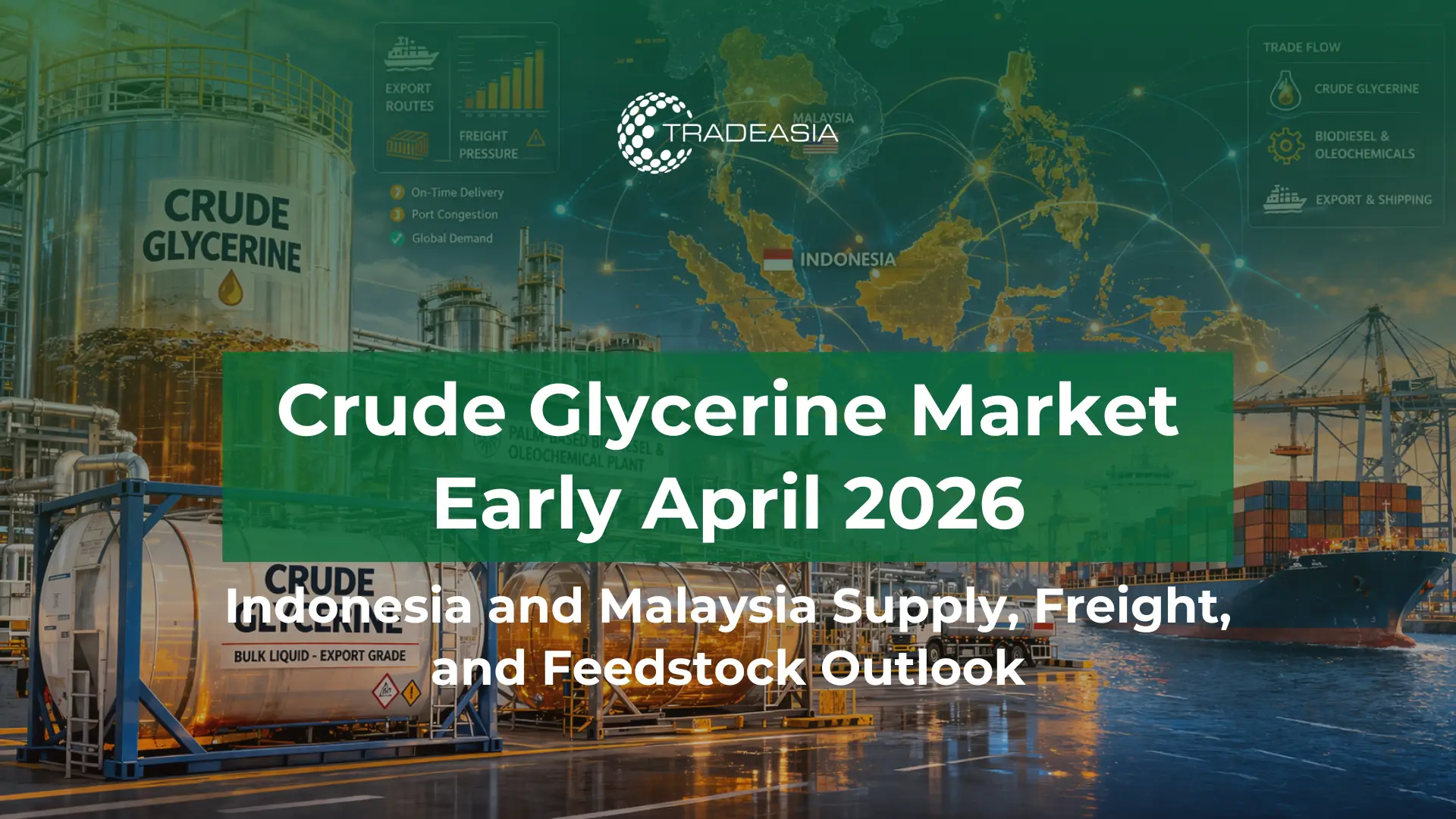
Market Overview: Crude Glycerine in April 2026 — Abundance at Origin, Tightness in Delivery
Crude Glycerine as a Biodiesel Co-Product: Production Structure and Supply Concentration
Indonesia and Malaysia: The Core of Exportable Crude Glycerine Supply
China and India: The Most Commercially Significant Demand Signals for Regional Sellers
Crude Glycerine Freight Risk: Hormuz Routing, Marine Insurance, and Delivered-Cost Elevation
Crude Glycerine Demand by Continent: Trade Flows and Buyer Profiles
Sourcing Strategy and Trade Outlook for Crude Glycerine Buyers in Q2–Q3 2026
The defining commercial paradox of the crude glycerine market 2026 in the March–April period is the coexistence of adequate physical supply at origin with elevated delivered cost economics at destination. This paradox arises when the factors governing the cost of moving a product — freight rates, marine insurance premiums, routing risk, port handling, and logistics lead time — increase materially without a corresponding change in the underlying production economics of the commodity itself. In the crude glycerine market, this is precisely the situation that has prevailed through early Q2 2026: crude glycerine producers in Southeast Asia are generating and offering product at commercially competitive FOB terms, while the total cost of landing that product at a buyer's facility in China, India, the Middle East, or Europe has been elevated by logistics variables that operate independently of the commodity supply-demand balance. According to market analysis published by ICIS, oleochemical markets in early 2026 have been characterised by this FOB-versus-CIF divergence, with sellers and buyers in crude glycerine trade both acknowledging that delivered price formation reflects logistics economics at least as much as commodity fundamentals.
The clearest commercial implication of the current market structure for crude glycerine buyers is that procurement analysis that focuses exclusively on the FOB supply availability picture will produce an incomplete and potentially misleading assessment of actual procurement economics. Physical crude glycerine supply is not the constraining variable in April 2026: biodiesel production in Indonesia and Malaysia continues at commercially active levels under national mandate-driven policy frameworks, generating co-product crude glycerine at a volume that is not materially constrained by feedstock availability or production capacity limitations. Chinese production from multiple pathways — including biodiesel, soap-making, and by-product chemical processes — adds further supply to the regional market. What is constraining is the delivered cost discipline required to source competitively from origins with elevated logistics risk, and the commercial management of that constraint through sourcing strategy is the primary procurement challenge of the period. According to Oils & Fats International, Southeast Asian oleochemical markets in early 2026 have seen stable export volumes from primary origins with pricing pressure from the demand side rather than supply-side tightening.
The overall market tone for crude glycerine in April 2026, assessed on a delivered basis rather than an FOB basis, is mixed-to-firm — a characterisation that reflects the complexity of the forces at work. On the supply side, adequate production and active export willingness from primary origins apply moderate downward pressure on FOB pricing. On the logistics side, elevated freight rates, marine insurance cost premiums driven by routing risk concerns, and ISO tank equipment availability constraints on key trade lanes apply upward pressure on total delivered cost. The net result is a market where buyers who have secured freight arrangements and logistics capacity ahead of spot market conditions are experiencing materially more favourable delivered economics than those dependent on spot logistics booking, and where the value of an integrated supply-and-logistics partner — capable of managing both the commodity sourcing and the physical delivery in a coordinated manner — is at a premium. This market tone is expected to persist through Q2 and into the early weeks of Q3 unless either freight conditions normalise significantly or production-side supply tightening creates a fundamentally different market structure.
For procurement managers and trading professionals navigating the April 2026 crude glycerine market, the practical intelligence from the current period can be summarised in two commercially actionable principles. First, total landed cost modelling — not FOB price benchmarking — is the appropriate analytical framework for assessing the economics of crude glycerine sourcing in the current logistics environment. Second, the value of logistics-capable, integration-oriented supply partners who can manage both origin procurement and delivery logistics is higher in this market than in periods of logistics normalcy, and investing in these supply relationships delivers commercial returns that exceed those available through purely transactional procurement approaches. According to Chemical Week's oleochemical market commentary, buyers who have established structured supply and logistics arrangements for crude glycerine entering Q2 2026 are reporting better supply continuity and more predictable delivered cost outcomes than those managing procurement and logistics independently through separate market-rate arrangements.
Crude glycerine biodiesel co-product dynamics are the structural foundation of global crude glycerine supply, and understanding this relationship is essential to interpreting the production availability picture in any given market period. In the transesterification reaction that converts vegetable oil or animal fat with methanol into fatty acid methyl esters (biodiesel), crude glycerine is generated in a fixed stoichiometric ratio of approximately 10% by weight of biodiesel output — meaning that for every 100 tonnes of biodiesel produced, approximately 10 tonnes of crude glycerine are inevitably generated as a co-product, regardless of market conditions for glycerine itself. This structural co-production relationship means that crude glycerine supply volumes are driven by biodiesel production decisions rather than by glycerine supply-demand economics, and crude glycerine producers cannot directly adjust their output to respond to glycerine market conditions without simultaneously affecting their primary biodiesel production. According to the International Energy Agency (IEA), global biodiesel production continued its long-term growth trajectory into 2025 and 2026, driven by government blending mandates in key producing countries, generating a corresponding increase in co-product crude glycerine availability that has been a persistent feature of the supply landscape.
The geographic concentration of crude glycerine supply in Southeast Asia — and the mandate-driven character of that supply — is a structural feature of the crude glycerine global supply landscape that distinguishes it from other commodity chemical markets. Indonesia's biodiesel blending mandate, which has been progressively increased toward B40 targets under national energy policy, and Malaysia's corresponding Palm Oil Industrial Cluster (POIC) biodiesel industry together make Southeast Asia the world's most significant exporter of palm-based crude glycerine. The mandate-driven character of this production means that Southeast Asian crude glycerine supply is not primarily responsive to glycerine market pricing signals — it is driven by government energy policy that mandates biodiesel blending regardless of short-term commodity economics. This policy insulation creates a supply base whose volume is relatively stable and predictable on a medium-term basis, providing crude glycerine buyers with a degree of supply security certainty that would not exist if production were driven purely by market economics. According to the Indonesian Ministry of Energy and Mineral Resources, Indonesia's biodiesel programme mandates have been progressively implemented and remain a core pillar of national energy diversification policy, ensuring continued crude glycerine co-production at commercial scale through the foreseeable policy horizon.
The crude glycerine global supply picture extends beyond Southeast Asian palm biodiesel co-production to include several other important supply streams that add geographic and feedstock diversity to the market. Animal fat-based biodiesel production in the United States and Europe generates crude glycerine with a distinct composition profile — reflecting the different fatty acid composition of tallow, lard, and rendered fat feedstocks compared to palm oil — that is commercially relevant for buyers whose downstream processing or application requirements create a preference for non-palm origin material. European rapeseed and used cooking oil biodiesel production generates further crude glycerine supply that is absorbed primarily within regional European markets. Chinese by-product glycerine from soap manufacturing and chemical synthesis adds a significant volume to the regional Asian supply picture that competes with Southeast Asian exports in destination markets across the continent. For buyers with origin preferences or specification requirements linked to feedstock type — including buyers seeking crude glycerine 80% minimum from animal fat USA origin for specific downstream applications — the diversity of available supply origins provides meaningful commercial flexibility.
While the mandate-driven character of Southeast Asian biodiesel production provides supply stability in normal conditions, the geographic concentration of crude glycerine exportable supply in two countries — Indonesia and Malaysia — creates concentration risk that sophisticated buyers should address through their sourcing architecture. Any policy change, production disruption, or logistics event affecting either of these origins has an outsized effect on global traded crude glycerine availability, given their dominant share of internationally accessible supply. Environmental incidents at major palm oil processing facilities, changes to Indonesia's crude palm oil export policy that affect biodiesel economics, or port logistics disruptions at Belawan, Dumai, or Port Klang could rapidly reduce available export volumes and firm delivered prices in destination markets that are currently benefiting from adequate Southeast Asian supply availability. Buyers who supplement their Southeast Asian-origin sourcing with supply relationships across alternative origins — including U.S. animal fat-based material, European rapeseed-origin glycerine, or Chinese-origin supplementary supply — reduce their exposure to this geographic concentration risk at a modest additional procurement complexity cost.
Crude glycerine Indonesia export volumes make Indonesia the single most commercially important origin in the globally traded crude glycerine market, and the commercial conditions prevailing at Indonesian origin in April 2026 are therefore the primary reference point for buyers and traders assessing global supply availability. Indonesian crude glycerine — palm-based, produced as a co-product of domestic biodiesel refining under the national blending mandate — is characterised by high glycerol content (typically 80% minimum on an 80/20 or similar commercial grade basis), a distinctive palm-derived impurity profile, and a supply logistics network built around the major Sumatran and Kalimantan palm processing corridors and their associated export port infrastructure. In April 2026, Indonesian production has remained commercially active, with no major operational disruptions reported across the primary biodiesel producing regions. For buyers seeking palm-origin crude glycerine with strong availability and competitive FOB pricing, reviewing crude glycerine 80% min palm from Indonesia provides direct access to specification and commercial terms for this primary origin.
Crude glycerine Malaysia supply complements the Indonesian origin picture with a production base that, while smaller in absolute export volume than Indonesia's, is commercially important in its own right and serves as an alternative or supplementary source for buyers managing origin diversification within the palm glycerine family. Malaysian crude glycerine — produced from palm oil-based biodiesel and oleochemical processing at facilities in Sabah, Pahang, Johor, and other palm processing states — shares the basic palm-derived feedstock character of Indonesian material while offering buyers a distinct origin geography, separate logistics routing, and in some cases different quality characteristics reflecting the specific biodiesel production configurations of Malaysian processors. The Malaysian oleochemical sector, with its well-developed export infrastructure at Port Klang, Pasir Gudang, and other facilities, provides accessible logistics for buyers in the Indian Ocean, South Asian, and East Asian destination markets that are the primary consumers of Southeast Asian crude glycerine. For buyers whose procurement frameworks require origin diversification within the palm glycerine category, maintaining active sourcing relationships with both Indonesian and Malaysian suppliers provides meaningful supply security without requiring feedstock type diversification.
Within the Southeast Asian crude glycerine supply landscape, the high-MONG (Matter Organic Non-Glycerol) grade represents a commercially distinct product tier that is relevant to specific downstream processing configurations and application requirements. High-MONG crude glycerine is characterised by higher organic impurity content alongside its glycerol fraction, reflecting production conditions or feedstock compositions that generate more complex organic co-products in the crude glycerine stream. For buyers whose refining or downstream processing technology can accommodate or specifically benefits from elevated MONG content — including certain oleochemical conversion applications where the MONG fraction participates beneficially in downstream chemistry — high-MONG crude glycerine may represent both a cost-competitive sourcing option and a technically appropriate raw material. Buyers evaluating crude glycerine 80% min palm high MONG grade should assess their specific processing technology's MONG tolerance and downstream application requirements before committing to this grade as a primary supply specification, and should confirm through analytical testing that the material's composition is consistent with their process design parameters.
The physical movement of crude glycerine from Indonesian and Malaysian production facilities to export positions and onward to destination markets involves a logistics chain whose efficiency and cost directly shape the delivered economics that buyers experience. Crude glycerine is a viscous liquid that requires ISO tank containers, flexitanks within standard containers, or in some cases dedicated bulk liquid tankers for efficient loading, transport, and discharge. ISO tank equipment availability at Indonesian export ports — a constraint that has periodically tightened in periods of high oleochemical export activity — is a logistics bottleneck that can add booking lead time and equipment cost to origin procurement, independent of the commodity pricing dynamics. Temperature management considerations during trans-equatorial ocean transit, where ambient conditions can affect glycerine viscosity and handling at discharge ports, add a further logistics management dimension that buyers and their logistics partners must account for. The combination of these physical logistics factors — equipment availability, temperature management, port handling, and transit routing — contributes to the delivered cost elevation that characterises the April 2026 market even in the presence of adequate FOB availability.
Crude glycerine China demand is the most commercially influential demand signal in the Asian regional crude glycerine market, and the conditions prevailing in the Chinese market in April 2026 are a primary determinant of the export pricing and volume absorption that Southeast Asian sellers experience. China's industrial demand for crude glycerine — driven by domestic oleochemical refining, personal care ingredient production, pharmaceutical synthesis, and industrial chemical conversion — represents a large and consistent volume pull that, when active and pricing-supportive, provides Southeast Asian exporters with a commercially attractive destination. China is simultaneously a major domestic crude glycerine producer — through biodiesel, soap manufacturing, and by-product chemical processes — and an importer that supplements domestic production to meet total industrial demand, creating a procurement environment in which domestic Chinese production economics set a floor below which imported material cannot be competitively priced after freight and logistics costs are added. According to market commentary published in Oils & Fats International, Chinese glycerine market conditions in early 2026 have been characterised by domestic oversupply pressure from Chinese producers competing for market share, which has moderated the pricing support that Southeast Asian exporters might otherwise receive from strong Chinese demand.
The dynamic of Chinese domestic glycerine oversupply — in which Chinese-origin crude glycerine from domestic biodiesel and by-product production competes aggressively with imported Southeast Asian material in the Chinese domestic market — has broader implications for the global crude glycerine trade landscape that extend beyond the China-Southeast Asia bilateral trade relationship. When Chinese domestic producers cannot absorb their production into domestic demand at commercially acceptable margins, they redirect material into export markets — including Southeast Asian, Indian, and Middle Eastern destinations — creating competitive supply pressure in those markets that moderates the pricing power of Southeast Asian exporters selling into the same destinations. This Chinese export spillover dynamic is an important competitive variable for crude glycerine producers in Indonesia and Malaysia to manage, as Chinese-origin material appearing in their traditional export markets at aggressive pricing can erode both price levels and volume capture. According to ICIS, the crude glycerine trade in early 2026 has been influenced by this multi-directional competitive dynamic, with Chinese, Indonesian, and Malaysian origins simultaneously active in some common destination markets under different cost and logistics economics.
Crude glycerine India imports represent one of the most commercially significant and growing demand channels in the Asian regional market, driven by the expansion of India's domestic oleochemical processing, personal care manufacturing, pharmaceutical production, and industrial chemical sectors that collectively create substantial crude glycerine import requirements. India's domestic biodiesel programme, while growing, does not yet generate crude glycerine at a volume sufficient to meet domestic refining and industrial demand, making India a consistent net importer with import volumes that track the growth trajectory of its downstream processing industries. Indian buyers are known for price sensitivity and procurement discipline — seeking competitive CIF pricing from multiple competing origins and leveraging India's position as a large, commercially attractive destination to achieve competitive landed cost terms. The freight economics of the key crude glycerine trade lanes into India — including from Indonesian and Malaysian origins via the Indian Ocean, from Chinese origins via the Bay of Bengal, and from U.S. origins via longer trans-oceanic routing — create a competitive origin comparison framework for Indian buyers that is directly affected by the freight and logistics conditions characterising the April 2026 market. For sellers, India's import demand represents both a volume opportunity and a competitive challenge where logistics cost management is critical to commercial success.
The commercial landscape that Southeast Asian crude glycerine sellers navigate in April 2026 involves simultaneous demand engagement with Chinese buyers (whose domestic oversupply moderates import pricing), Indian buyers (whose price sensitivity and logistics cost awareness create competitive procurement pressure), Middle Eastern buyers (whose routing exposure affects delivered cost), and smaller volume buyers across Southeast Asia, East Africa, and other regional markets. This multi-destination demand picture creates both opportunity — in the form of multiple alternative markets that sellers can access when pricing in one destination weakens — and complexity, in the form of logistics management across multiple trade lanes with different freight cost structures and risk profiles. For sellers managing export allocation across these competing destination markets, understanding the current freight economics of each trade lane and the relative pricing attractiveness of each destination is the core commercial intelligence required to optimise both volume placement and price realisation in the current market environment.
Crude glycerine freight risk in April 2026 has been particularly shaped by concerns around shipping routing through and near the Strait of Hormuz, the narrow waterway connecting the Persian Gulf to the Indian Ocean through which a significant proportion of global energy and commodity trade passes. Disruption risk or threat perception around the Strait of Hormuz — whether from geopolitical tensions, naval incident concerns, or maritime security advisories — has a direct commercial impact on chemical trade routes that traverse the Arabian Sea and Indian Ocean between Southeast Asian origins and Middle Eastern and South Asian destination markets. When carriers and shippers perceive elevated risk on trade lanes passing through or near Hormuz-adjacent waters, vessel routing adjustments — including longer alternative routes that avoid the highest-risk segments — add transit time and fuel cost, while marine war risk insurance premiums for vessels on affected routes increase materially, adding to the total shipping cost even when physical passage is not interrupted. According to Lloyd's Market Association, maritime war risk pricing in early 2026 has reflected elevated risk assessments in the Middle East and Persian Gulf region, with insurance premium adjustments that have added meaningful cost to chemical shipment economics on affected trade lanes.
Beyond the specific Hormuz routing risk, container freight rate dynamics on the broader set of trade lanes relevant to crude glycerine distribution have contributed to the delivered-cost elevation characterising the April 2026 market. Crude glycerine is moved in ISO tank containers, flexitanks, or specialised liquid bulk containers — all of which are subject to container shipping rate dynamics rather than dry bulk freight economics. According to Drewry's World Container Index, container freight rates on key Asian export and Indo-Pacific trade lanes remained elevated in Q1 2026 relative to pre-pandemic historical norms, and the availability of specialised liquid container equipment — ISO tanks and flexitanks — has been subject to periodic tightening on high-demand trade lanes that reduces booking flexibility and adds equipment hire cost to total logistics expenses. The combination of elevated container rates, equipment availability constraints, and war risk premium addition on Middle Eastern routes creates a compounded freight cost environment that materially elevates the CIF delivered price of crude glycerine at Middle Eastern, South Asian, and certain East African destination ports above what the competitive FOB pricing at Southeast Asian origins would suggest.
The availability of ISO tank containers — the standard equipment type for bulk liquid chemical shipments including crude glycerine — is a frequently underappreciated logistics constraint that can add both cost and lead time to crude glycerine procurement even when commodity supply is available and freight booking is theoretically accessible. ISO tank equipment repositioning dynamics — in which equipment used to carry chemical exports from Southeast Asia to Middle Eastern or South Asian destinations must then be repositioned to reload origins — create utilisation patterns that can produce localised equipment shortages on specific trade lane segments when outbound cargo volumes exceed the pace of equipment repositioning. According to the International Tank Container Organisation (ITCO), ISO tank utilisation rates on Asian export lanes have remained elevated relative to historical averages through the current period, contributing to equipment availability constraints that add a logistics bottleneck dimension to the crude glycerine freight risk picture. For buyers who require ISO tank delivery — as opposed to flexitank or drum packaging alternatives — lead time for equipment availability at origin is a procurement planning variable that should be confirmed with logistics partners and factored into order timing and safety stock calculations.
The practical response to the elevated freight risk and cost environment characterising April 2026 crude glycerine logistics is structural rather than tactical: it involves building procurement and supply chain arrangements that reduce the buyer's real-time exposure to freight market volatility rather than managing that volatility on a transaction-by-transaction basis. Buyers who have established annual or semi-annual supply contracts with logistics-integrated suppliers — who have secured freight capacity, confirmed equipment availability, and pre-arranged insurance coverage as part of the overall supply arrangement — are accessing the market at a structurally more advantageous cost position than buyers who assemble their own logistics components on a spot basis in response to individual orders. Buyers who have the volume scale to negotiate direct carrier relationships — or to work with logistics intermediaries who aggregate volumes across multiple clients to achieve preferred carrier access — can further reduce their per-unit freight cost and improve their supply chain predictability relative to the spot logistics market. The commercial value of logistics integration in the current market environment is tangible and quantifiable, and procurement teams that treat logistics as a commodity afterthought are systematically overpaying for their crude glycerine supply relative to those who treat it as a strategic supply chain management dimension. Buyers who want to access comprehensive product and logistics documentation to support their supply chain planning can download relevant materials through the Oleochemicals Asia Download Center, including product data sheets, SDS documentation, and specification summaries for crude glycerine from qualified origins.
Crude glycerine demand by continent is most heavily concentrated in Asia, which simultaneously hosts the world's dominant production base and the largest consuming industries for crude glycerine in its refined and processed forms. The intra-Asian crude glycerine trade — particularly from Southeast Asian origins into Chinese and South Asian destination markets — is the most commercially active trade lane in global crude glycerine distribution, and the conditions governing this trade in April 2026 are shaped by the competitive dynamics among Indonesian, Malaysian, and Chinese-origin supply discussed earlier in this article. India's growing import demand — driven by its expanding personal care, pharmaceutical, and oleochemical refining sectors — makes the Southeast Asia-to-India trade lane one of the most commercially significant bilateral flows in the global market. Beyond China and India, other Asian consuming markets including South Korea, Japan, Taiwan, and the ASEAN nations collectively represent a meaningful supplementary demand base that absorbs both regionally produced and imported crude glycerine across a range of industrial applications. According to the United Nations Comtrade database, intra-Asian glycerine and polyol trade flows have grown consistently over the past five years, confirming the structural importance of the Asian regional market as the primary driver of global crude glycerine trade volume.
Europe's role in the global crude glycerine market is defined by its position as a significant refining and processing hub — European glycerine refiners process crude glycerine into refined, USP-grade, and specialty glycerine products for the personal care, pharmaceutical, and food sectors — as well as a consumer of crude glycerine from its own biodiesel industry. European crude glycerine supply is generated domestically from rapeseed and used cooking oil biodiesel production, with major European producers including refiners in Germany, France, the Netherlands, and Belgium operating at commercial scale. Import of crude glycerine from Southeast Asian and other origins supplements domestic production when regional supply tightens or when pricing differentials justify importation. European crude glycerine trade is subject to the EU's chemical regulatory framework — including REACH compliance for imported materials — and sustainability documentation requirements linked to the Renewable Energy Directive (RED) for biodiesel-derived crude glycerine, creating a documentation burden for importers that is more extensive than in many other destination markets. According to the European Oleochemicals Association (APAG), European glycerine refining capacity has been utilised at commercially active rates through early 2026, with balanced supply from domestic and import sources maintaining orderly refining economics.
The Middle East and Africa represent import-dependent crude glycerine consuming markets whose supply security is directly determined by the freight and logistics conditions governing the trade lanes connecting them to Southeast Asian and other producing origins. Middle Eastern glycerine consumers — including soap and detergent manufacturers, cosmetics producers, and industrial chemical processors — import predominantly from Southeast Asian origins, with the logistics routing challenges discussed in the freight risk section directly affecting their delivered cost and supply security. Sub-Saharan African buyers — primarily in soap and cleaning products manufacturing in Nigeria, Kenya, South Africa, and Ethiopia — similarly depend on import supply from Southeast Asian origins, with the additional logistical complexity of more limited port infrastructure and less regular shipping services in some destination markets. For sellers targeting these markets, the logistics management challenge is proportionally more significant than for well-served Asian or European destinations, and the commercial value of logistics capability is correspondingly higher in these markets. Buyers in Middle Eastern and African markets who want to discuss supply arrangements for crude glycerine tailored to their specific logistics and documentation requirements are encouraged to contact the Oleochemicals Asia sourcing team to explore commercially appropriate supply solutions.
North America's crude glycerine market is characterised by substantial domestic production from the U.S. biodiesel industry — including soybean oil and animal fat-based biodiesel production that generates crude glycerine from multiple origin types — combined with a domestic glycerine refining sector that absorbs the majority of domestically produced crude material. U.S. animal fat-derived crude glycerine — produced as a co-product of tallow and lard-based biodiesel at rendering-integrated operations — has a distinct compositional profile from palm-based Southeast Asian material and serves as an important alternative origin for buyers with non-palm specification requirements or North American sourcing preferences. South American crude glycerine production — primarily from Brazilian soybean biodiesel — similarly serves mainly domestic Brazilian refining and industrial demand, with limited commercial export volumes reaching global markets outside the Americas. For specialty buyers seeking crude glycerine 80% minimum from animal fat USA origin as a non-palm alternative with specific compositional characteristics relevant to their downstream processing or application requirements, U.S. animal fat-derived crude glycerine represents a commercially credible supply option with established quality standards and export logistics.
The crude glycerine trade outlook through Q2 and into Q3 2026 supports a procurement approach built on three strategic principles: total delivered cost optimisation over FOB price minimisation, logistics risk management as an integral component of supply chain structuring, and origin diversification that provides both commercial flexibility and supply security in a market where geographic concentration creates identifiable vulnerability. Buyers who apply these three principles in their Q2 procurement planning will consistently achieve better supply security and cost outcomes than those managing procurement on a transactional, price-first basis. The current market environment — adequate supply availability at origin, elevated logistics costs, and firm but not escalating delivered pricing — provides a commercially rational window for establishing structured supply arrangements at terms that are competitive relative to the underlying market conditions without requiring buyers to assume aggressive pricing positions that would be unsustainable if market conditions tighten.
For any buyer sourcing crude glycerine from Southeast Asian or other international origins in Q2–Q3 2026, total landed cost modelling — incorporating FOB commodity price, ocean freight, marine insurance, equipment hire, destination port handling, import duty, inland transport, and inventory carrying cost — is the analytical foundation without which procurement decisions are commercially unsound. The April 2026 market has demonstrated clearly that FOB price benchmarks without freight and logistics cost integration systematically understate actual procurement economics, and buyers who make origin selection and volume commitment decisions based on FOB price comparisons alone will consistently fail to identify the commercially optimal sourcing configuration for their specific destination and logistics profile. Building a structured landed cost model that is updated monthly with current freight rates, insurance premiums, and destination logistics costs is a procurement investment that returns commercial value many times its implementation cost through better origin selection, better timing of forward commitments, and better supplier negotiating position.
The freight risk dimensions documented throughout this article — Hormuz routing concerns, ISO tank availability constraints, and container rate elevation — are not expected to fully normalise in the near term, and buyers whose supply chains lack logistics resilience will continue to face the delivered cost penalties and supply schedule variability that the current environment imposes. Building logistics resilience means securing freight capacity commitments ahead of spot market booking, maintaining relationships with multiple logistics providers on each key trade lane, specifying contractual lead time requirements and equipment availability standards in supply agreements, and maintaining safety stock buffers calibrated to actual logistics variability rather than historical norms. Buyers who have already implemented these logistics resilience measures are experiencing meaningfully better supply chain outcomes than those who have not, and the current period of logistics disruption risk provides a strong commercial incentive for buyers who have not yet invested in supply chain resilience to initiate these structural improvements before the next disruption event forces a reactive response under less favourable conditions.
The combination of adequate supply availability, elevated logistics cost, and structured demand from the key consuming markets of China, India, and Europe creates a market environment in April 2026 in which well-positioned sellers are both willing and commercially incentivised to engage in structured supply discussions with qualified buyers who can offer volume commitment, logistical clarity, and payment terms that provide commercial certainty. Buyers who approach supplier engagement in Q2 with clear specification requirements, defined volume commitments for the quarter and the next, and logistics terms that reflect the current market reality — rather than seeking to achieve historical price levels that do not reflect current freight economics — are most likely to secure both competitive pricing and reliable supply. For procurement managers ready to initiate or expand their crude glycerine sourcing relationships across palm-based Indonesian, high-MONG, U.S. animal fat, or other origin options, engaging with a qualified, logistics-capable supply partner is the most commercially effective path to Q2–Q3 supply security. Buyers are encouraged to explore the full range of origin options and engage in a formal supply discussion with the Oleochemicals Asia commercial sourcing team to access competitive terms, origin-specific specification data, and logistics solutions tailored to their destination market requirements and application needs.
We're committed to your privacy. Tradeasia uses the information you provide to us to contact you about our relevant content, products, and services. For more information, check out our privacy policy.


 English
 Indonesian
 简体字
简体字
 العربية
 Español
 Français
 Português
 日本語
日本語
 한국어
한국어
 Tiếng Việt