Explore our network of country and industry based websites to access localized information, product offerings, and business services across our group.

Access reliable chemical market information through our update channels.
Real-time Updates
Daily Updates
Log in to start sending quotation requests for any product.
Don't have an account? Sign Up Here
Home The B45 Disruption: How Biofuel Mandates are Squeezing Stearyl Alcohol Feedstock
Trade Insights | Supply Chain | 05 February 2026
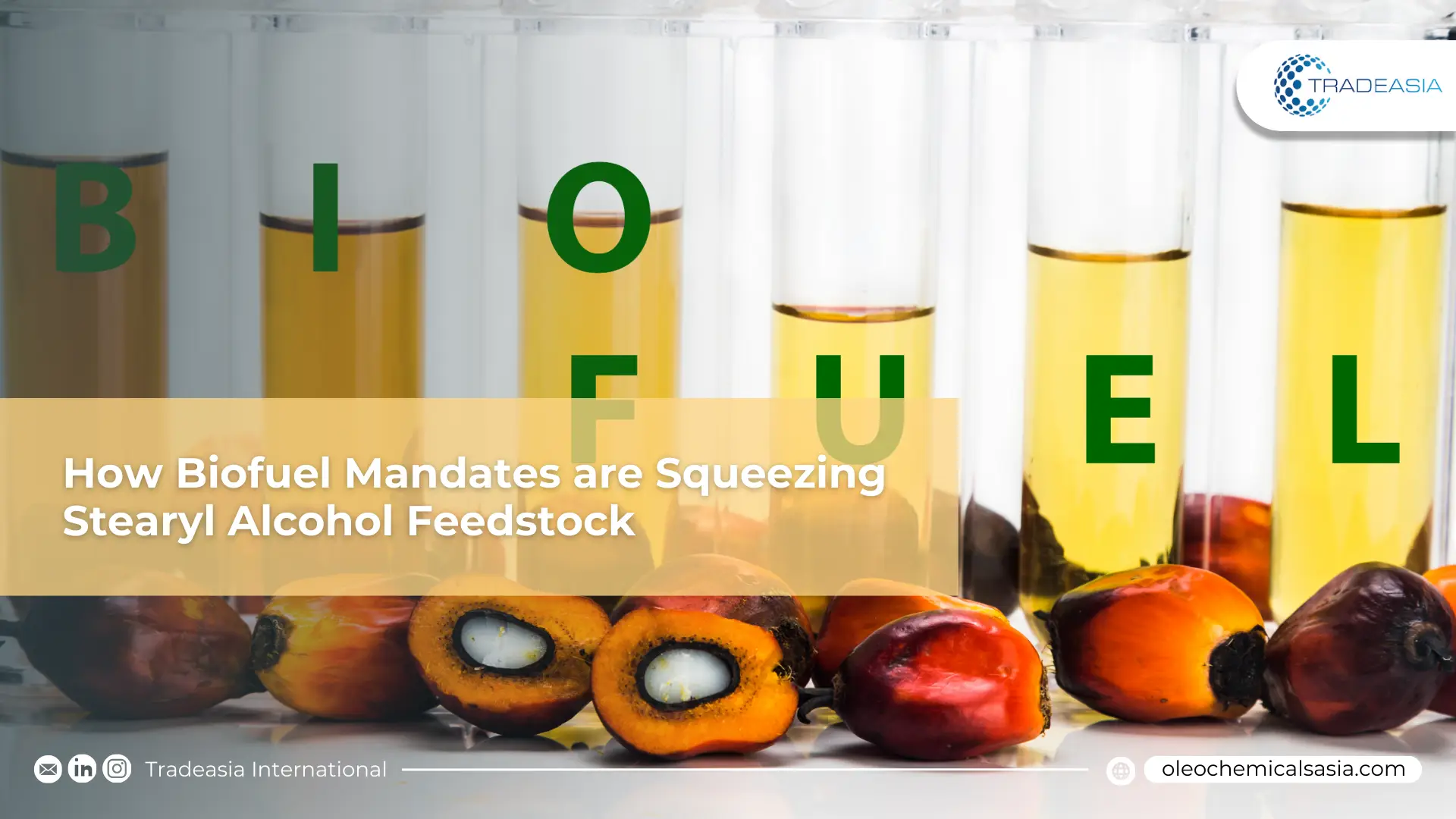
The global stearyl alcohol market enters February 2026 facing a structural paradox: burgeoning demand for high-purity emollients is being met with a tightening feedstock bottleneck that shows no signs of easing. As of February 4, 2026, the supply of Crude Palm Kernel Oil (CPKO)—the essential precursor for C18 fatty alcohols—is under immense pressure due to Indonesia's aggressive transition toward the B45 biodiesel mandate. This policy has effectively diverted massive volumes of palm kernel fractions away from the oleochemical industry and into the energy sector to meet domestic carbon-reduction targets. Consequently, spot prices for industrial-grade stearyl alcohol have ascended to a high of USD 2,600 per MT (FOB Southeast Asia), representing a significant year-on-year climb that has caught many mid-stream manufacturers off guard as they scramble to secure Q1 and Q2 volumes.
To navigate this era of energy-driven feedstock competition, procurement managers are increasingly relying on sophisticated supply chain partners who can secure material amidst regional scarcity. Tradeasia International serves as a critical bridge in this volatile landscape, providing seamless distribution and logistical transparency for palm-based oleochemicals. By maintaining deep-rooted relationships with tier-one refineries across Indonesia and Malaysia, Tradeasia ensures that global manufacturers receive consistent supplies of stearyl alcohol, effectively insulating their production lines from the immediate shocks of local biofuel policy shifts and regional logistical bottlenecks.
The transition from B40 to B45 in late 2025 has fundamentally altered the marginal cost of production for all C16-C18 derivatives, as the "energy premium" on palm kernel oil is currently estimated at USD 350–400 per MT over traditional food-grade benchmarks. This competition is reflected in the stearyl alcohol market valuation, which is projected to reach USD 7.02 billion globally by the end of 2026. Producers are now operating under a "double-squeeze" scenario; while feedstock costs are rising due to biodiesel blending, the demand for high-purity pharmaceutical grades (98%+) is also surging, often commanding a 30% price premium due to the intensive energy and distillation time required to separate the C18 fraction from its C16 palmitic base.
Looking forward to 2046, stearyl alcohol is positioned to remain a dominant platform chemical, though its feedstock origin will likely undergo a radical transformation toward "Circular Oleochemicals." We anticipate the market will maintain a steady CAGR of 4.5% to 5.2% over the next two decades as the world pivots toward bio-attributed surfactants and advanced phase-change materials (PCMs) for sustainable building insulation. Stearyl alcohol's inherent biodegradability and low toxicity ensure its long-term viability as a green alternative to petroleum-based synthetic alcohols, securing its place as a critical asset in the global chemical hierarchy well into the mid-century.
Sources:
We're committed to your privacy. Tradeasia uses the information you provide to us to contact you about our relevant content, products, and services. For more information, check out our privacy policy.


 English
 Indonesian
 简体字
简体字
 العربية
 Español
 Français
 Português
 日本語
日本語
 한국어
한국어
 Tiếng Việt



















